

8 Antique Halo Engagement Ring Styles Ranked by Era and Diamond Cut

Why Halo Rings Have Looked Different in Every Century
Most people think of the halo as a modern invention — a sparkly border around a solitaire, popularized sometime in the last twenty years. But the concept of surrounding a center stone with smaller diamonds dates back to the Georgian era, roughly 1714 to 1837. What changed across the centuries wasn’t the idea; it was the metal, the diamond cut, the geometry, and the cultural mood behind each design.
The eight styles below are ranked from oldest to most recent, moving through Georgian cluster halos, three distinct phases of the Victorian era, Art Nouveau, Edwardian, Art Deco, and the Retro-to-Mid-Century transition. Each style has a signature diamond cut and a specific metalworking vocabulary. Understanding those differences is what separates a buyer who falls in love with the right ring from one who ends up with a vague “vintage look” they can’t quite explain.
A note on terminology: a ring is technically antique once it passes 100 years old. As of 2026, that means anything made before 1926 qualifies. Rings from 1926 to 1976 are vintage. Several styles on this list straddle that line, and we’ve noted where relevant.
1. Georgian Foil-Backed Rose Cut Cluster Halo (1714–1837) — The Rarest of All
Georgian cluster halos are the starting point for every halo ring that followed, and they look unlike anything made afterward. The signature combination is a domed rose cut diamond at center — flat-bottomed, with anywhere from 3 to 24 triangular facets rising to a soft peak — surrounded by a tight orbit of smaller rose cuts, all mounted in closed silver settings backed with reflective metallic foil.
That foil backing wasn’t decorative. Before gas lamps and electric light, jewelers needed every trick available to make diamonds appear brilliant by candlelight. The silver foil behind each stone amplified the diamond’s natural glow and created the illusion of greater depth in a relatively shallow cut. Rose cut diamonds, dating back to the 16th century, were particularly well-suited to this technique because of their flat base and domed top — the foil sat flush beneath the stone and bounced light back upward through the facets.
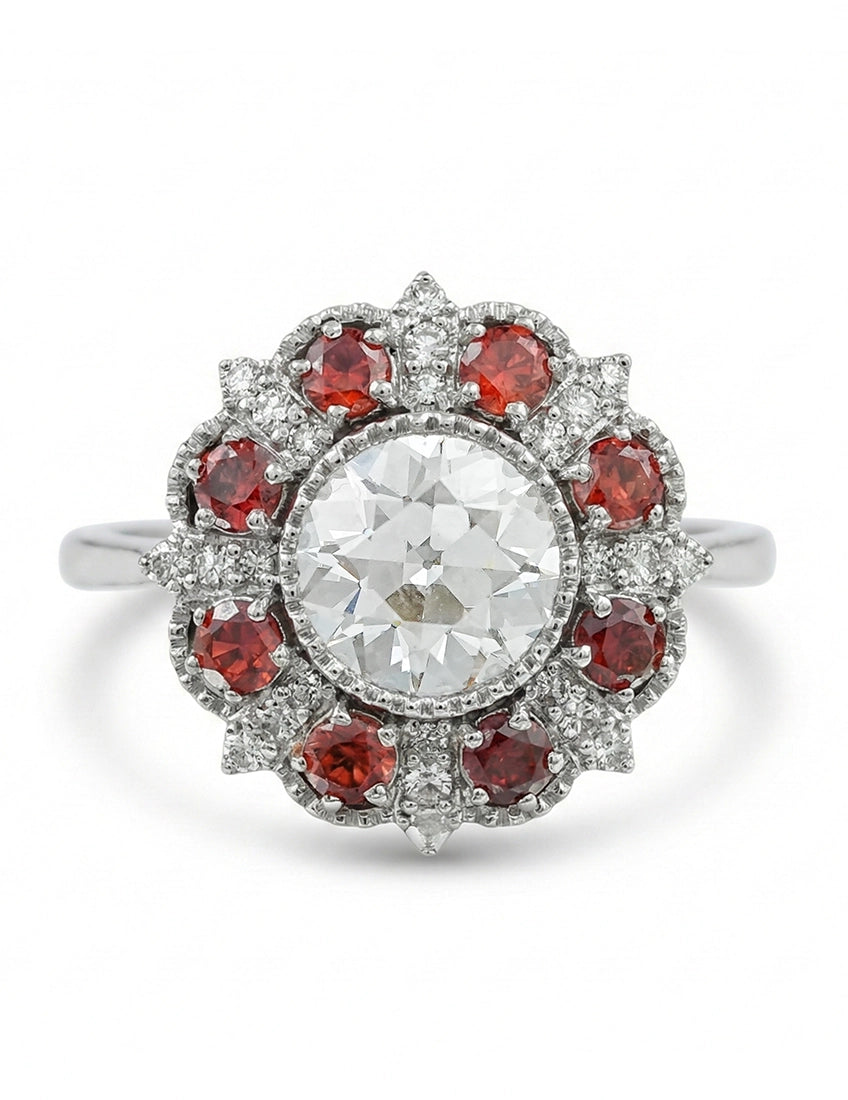
The metalwork on Georgian rings was entirely handmade. Common motifs included C-scroll shoulders, engraved bezels, and basket-weave backs that jewelers now use as a dating tool. Settings were typically silver over gold — platinum wasn’t yet workable — and the bands were often 14k to 18k yellow gold.
Why it ranks #1: Rarity. Authentic Georgian pieces are among the hardest antique jewelry items to find in wearable condition, and many surviving examples are too delicate for daily wear. They are collector’s pieces first, engagement rings second — though reproductions in the Georgian style are made today with modern construction techniques that solve the durability problem.
Diamond cut: Rose cut Metal: Silver over yellow gold, foil-backed closed settings Collector note: Foil-backed stones should never be submerged in water, as moisture damages the foil and permanently dulls the stone’s reflectivity.
2. Early Victorian Floral Cluster Halo — Old Mine Cut in Yellow Gold (1837–1861)
When Queen Victoria took the throne in 1837, sentimental jewelry became a cultural institution. Early Victorian rings, sometimes called Romantic Period pieces, leaned heavily on floral symbolism — a cluster of diamonds arranged to resemble a blooming flower was as much a statement of feeling as it was a design choice.
The dominant diamond cut shifted from the rose cut to the old mine cut: a softly squared, cushion-shaped stone with a high crown, small table, large culet, and deep pavilion. Old mine cuts were hand-shaped to follow the natural octahedral form of the rough diamond, which is why no two are perfectly symmetrical. Their proportions were optimized for candlelight, producing a warm, romantic glow rather than the sharp white sparkle of modern brilliants.
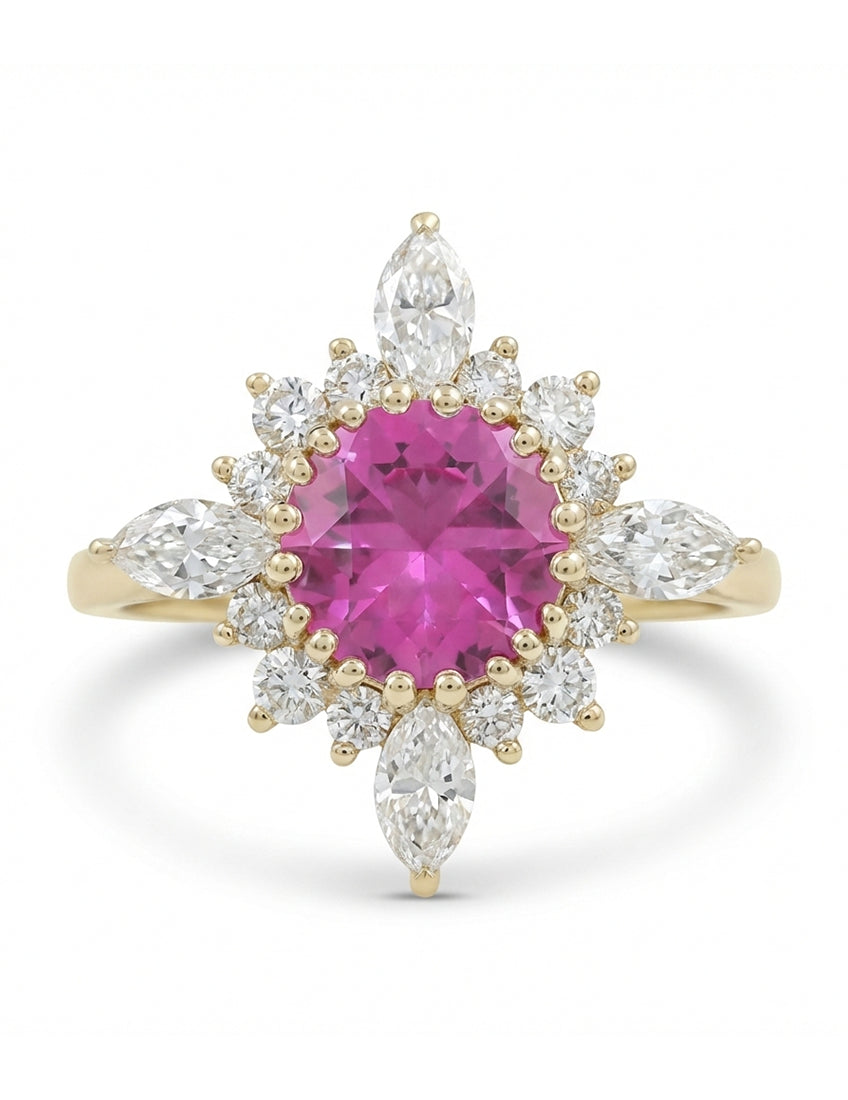
In early Victorian cluster halos, an old mine cut center stone sits in a silver collet, surrounded by six to eight old mine accent diamonds in a tight floral arrangement. The band is typically 14k to 18k yellow gold, and the silver setting for the diamond head creates a deliberate two-tone contrast. Lacy openwork shoulders were common, adding negative space that lightened the overall profile.
These rings sit low on the finger. The cluster head rarely rises more than 5–6mm above the band, which is part of what makes them practical for everyday wear compared to many modern halo designs.
Diamond cut: Old mine cut Metal: Silver over yellow gold Distinguishing detail: Visible culet (the flat or pointed bottom facet of the diamond) when viewed from above — a characteristic that modern buyers either love or find surprising on first encounter.
3. Late Victorian Daisy Halo — Old Mine Cut with Colored Stone Centers (1861–1901)
The Grand Period and Aesthetic Period of the Victorian era (roughly 1861–1901) produced a specific halo variant that’s become one of the most recognizable antique ring silhouettes: the daisy cluster. A colored gemstone — sapphire, ruby, emerald, or occasionally garnet — sits at the center, ringed by old mine cut diamonds in a circular arrangement that reads, unmistakably, as a flower.
Victorian halo rings from this phase often featured colored gemstones as center stones surrounded by slightly smaller diamonds, colored gemstones, or even pearls. The resulting ring typically resembled a flower, which was very much the point. Yellow gold remained the dominant metal, though silver-topped settings for the diamond heads were still common.
What distinguishes late Victorian daisy halos from their earlier counterparts is scale and confidence. The stones are often larger, the settings more pronounced, and the symbolism more deliberate. A sapphire center surrounded by old mine cut diamonds wasn’t just pretty — it carried specific meaning in the Victorian language of gems, where sapphires represented fidelity and truth.
These rings have seen a strong revival in 2026 among buyers who want something that reads as an engagement ring but doesn’t follow the conventional diamond-center format. The colored stone center with a diamond halo is, in fact, one of the oldest halo configurations in existence.
Diamond cut: Old mine cut (accent stones); colored gemstone center Metal: Yellow gold, silver-topped settings Best for: Buyers who want historical authenticity with a non-traditional center stone.
4. Art Nouveau Organic Halo — Rose Cut in Yellow or White Gold (1890–1910)
Art Nouveau jewelry emerged in France around 1890 as a deliberate rejection of industrial mass production, favoring sinuous curves, flowing lines, and imagery drawn from the natural world. In ring design, this translated to halos that didn’t look like halos at all — they looked like petals, wings, or leaves curling around a center stone.
The rose cut made a partial comeback during Art Nouveau, valued for its soft, low-profile glow rather than intense sparkle. Art Nouveau designers like René Lalique and Georges Fouquet treated the diamond almost as a secondary element, subordinate to the metalwork itself. Enamelwork, plique-à-jour, and organic prong shapes (think tiny rosebuds or curling vine tendrils) defined the aesthetic.
Art Nouveau halo rings are the hardest of the eight styles to find in true antique form, partly because the movement was relatively short-lived and partly because many pieces were melted down or reset in subsequent decades. What survives tends to be exceptional — and priced accordingly. Reproductions in the Art Nouveau style are widely available, but the originals carry a sculptural quality that’s difficult to replicate with modern casting techniques.
Diamond cut: Rose cut, occasionally old mine cut Metal: Yellow gold, white gold, sometimes platinum in later pieces Distinguishing detail: Asymmetrical or organic halo shape — the surrounding stones follow a naturalistic outline rather than a geometric one.
5. Edwardian Filigree Halo — Old European Cut in Platinum (1901–1915)
The Edwardian era produced what many collectors consider the most technically accomplished halo rings in history. The invention of the oxyacetylene torch gave jewelers the ability to work platinum — a metal previously too difficult to manipulate — and the results were extraordinary.
Lace-like platinum settings, delicate filigree, milgrain edging, and old European cut diamonds define Edwardian engagement rings from the early 1900s. The old European cut (OEC) replaced the old mine cut as the dominant diamond style during this period: rounder, more symmetrical, with a circular girdle established by mechanical bruting introduced in the 1870s. OEC diamonds were designed to sparkle under gas and candlelight, prioritizing fire — the multi-colored rainbow flashes from within the stone — over the uniform white brilliance of modern cuts.
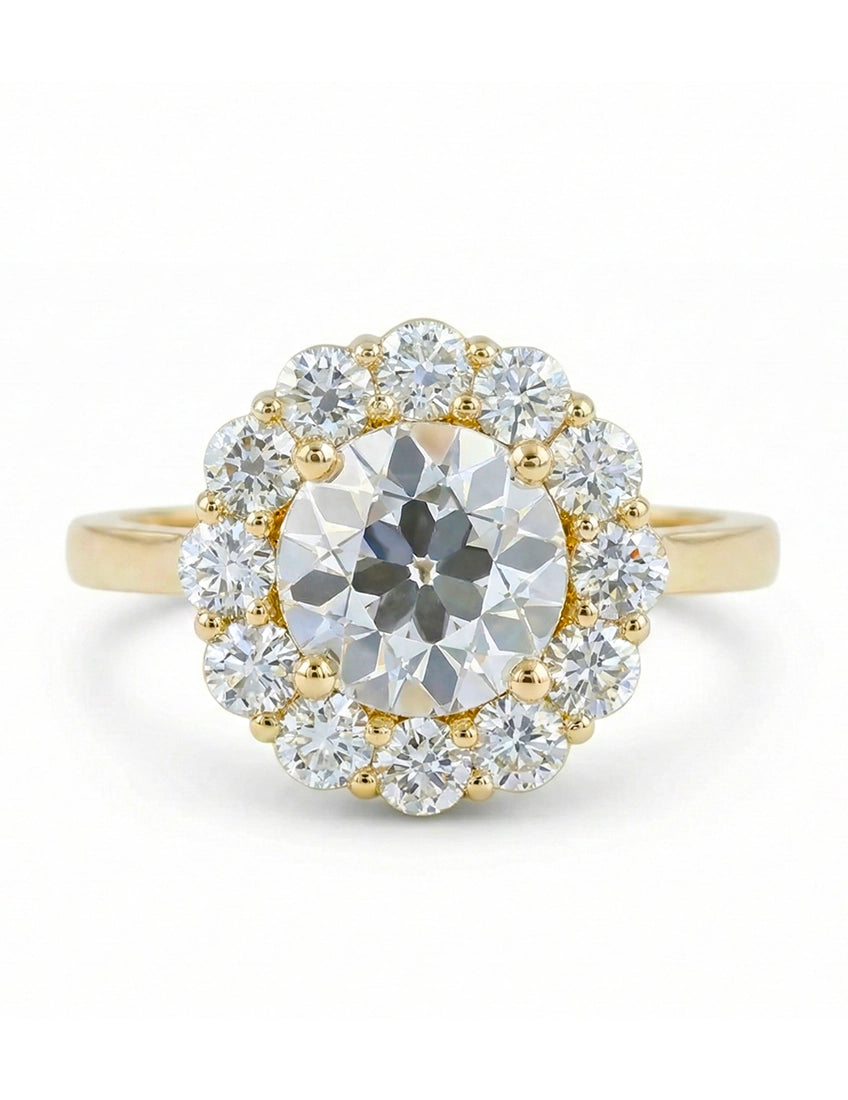
Edwardian halo rings typically feature an OEC center stone in a platinum bezel or claw setting, surrounded by a delicate ring of smaller old cuts or single-cut diamonds, all edged in milgrain. The filigree work on the shoulders and gallery is often described as resembling fine lace — thin strips of platinum twisted and woven into open, airy patterns. Flowing and floral garland motifs became so popular that the Edwardian period is sometimes called the “garland era.”
These rings are durable enough for daily wear (platinum is more resilient than silver over gold), and the OEC’s broader facets produce a warmer, more romantic light than a modern round brilliant. For buyers who want genuine antique construction with practical wearability, the Edwardian filigree halo is probably the strongest option on this list.
Old Gem House carries a curated selection of halo engagement rings featuring old European cut diamonds in period-appropriate settings, including custom work that reproduces Edwardian filigree techniques in solid platinum.
Diamond cut: Old European cut Metal: Platinum (occasionally 14k–18k white gold) Distinguishing detail: Open filigree gallery visible from the side profile — a hallmark of authentic Edwardian construction.
6. Art Deco Geometric Platinum Halo — Old European Cut with Octagonal or Hexagonal Frame (1920–1935)
Art Deco halo rings are the most architecturally distinct style on this list, and the most immediately recognizable. Where Edwardian rings were organic and flowing, Art Deco rings were angular, symmetrical, and built with the visual vocabulary of modernist architecture and industrial design.
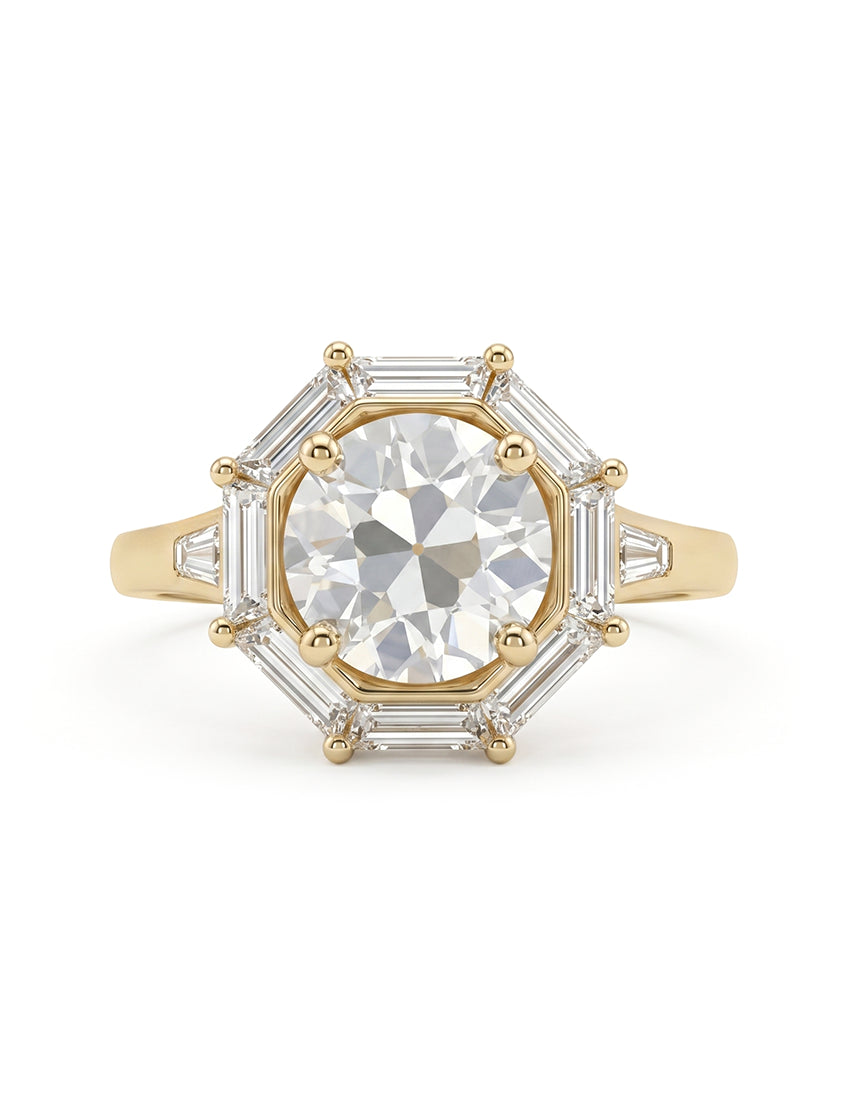
Art Deco engagement rings from the 1920s and 1930s are celebrated for their bold geometric designs, balanced symmetry, fine milgrain, hand-pierced filigree, and exceptional craftsmanship. The halo in an Art Deco ring is often not circular at all — octagonal, hexagonal, and square halos were common, surrounding an old European cut center stone with a frame that emphasized line and structure over softness.
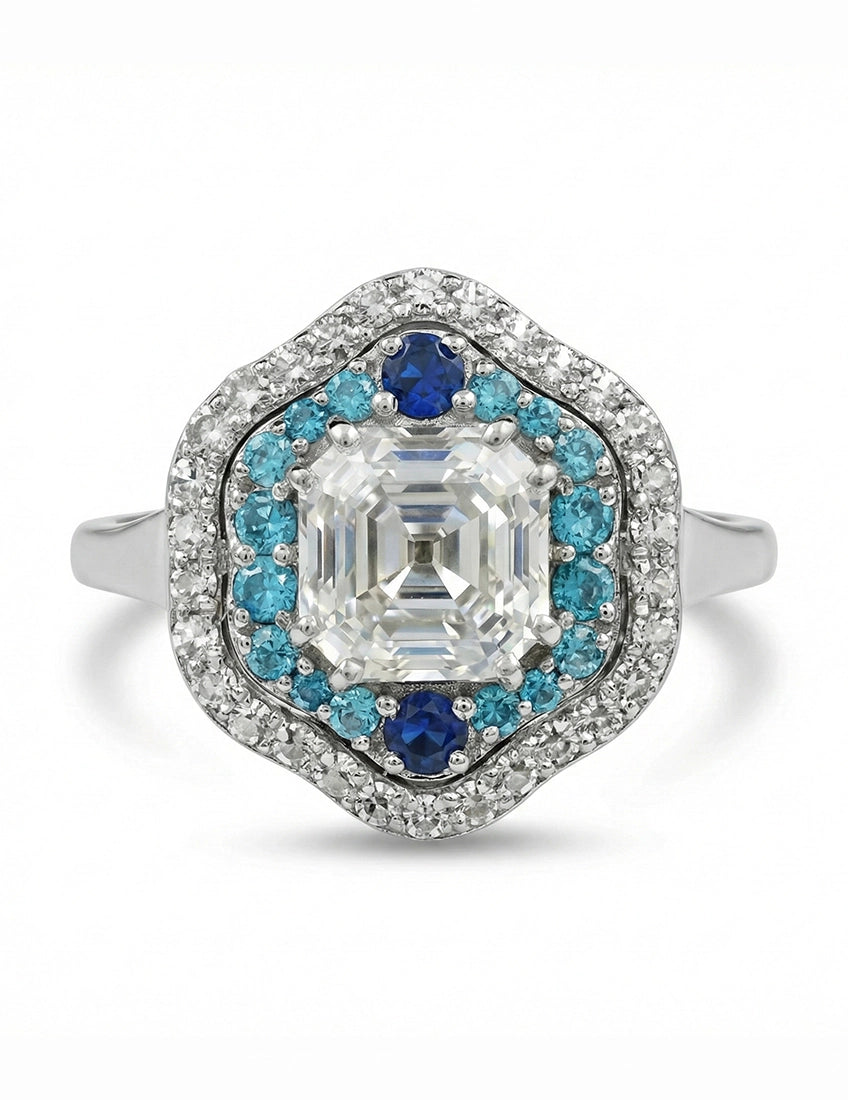
Platinum dominated early Art Deco (1920–1925), paired with white diamonds in monochromatic, architecturally precise compositions. Later pieces (1926–1935) introduced colored stones — sapphires, emeralds, rubies, and onyx — arranged in high-contrast geometric patterns. Baguette-cut accent stones were frequently used alongside old European cut centers, their rectangular facets reinforcing the era’s emphasis on clean lines.
Old European cut diamonds appear in Art Deco settings particularly in earlier pieces that used stones carried over or recut from the Edwardian period. Authentic Art Deco rings were hand-fabricated, and the metalwork under magnification will show tool marks and slight asymmetries that machine-made reproductions lack.
For buyers drawn to this style, Old Gem House specializes in old European cut diamonds sourced from original period jewelry, and offers custom design services to set them in Art Deco-inspired platinum or solid gold settings.
Diamond cut: Old European cut (center); baguette or single-cut (accent) Metal: Platinum (early), 18k white or yellow gold (late) Distinguishing detail: Non-circular halo geometry — the octagonal frame is the most collectible and most copied Art Deco halo configuration.
7. Retro Bold Halo — Old European or Transitional Cut in Yellow Gold (1935–1950)
Wartime restrictions on platinum during World War II pushed jewelry design back toward yellow and rose gold, and the Retro era (roughly 1935–1950) produced halo rings with a noticeably different character — bolder, more sculptural, with a Hollywood glamour aesthetic that contrasted sharply with Art Deco’s architectural restraint.
Retro halo rings often feature larger center stones — transitional cut diamonds (a bridge between the old European cut and the modern round brilliant) or later old European cuts — set in substantial yellow gold heads with wide, sculptural shoulders. The halos in this period tend to be rounder and more prominent than their Art Deco predecessors, with accent stones set in channel or pavé configurations rather than the open filigree of earlier eras.
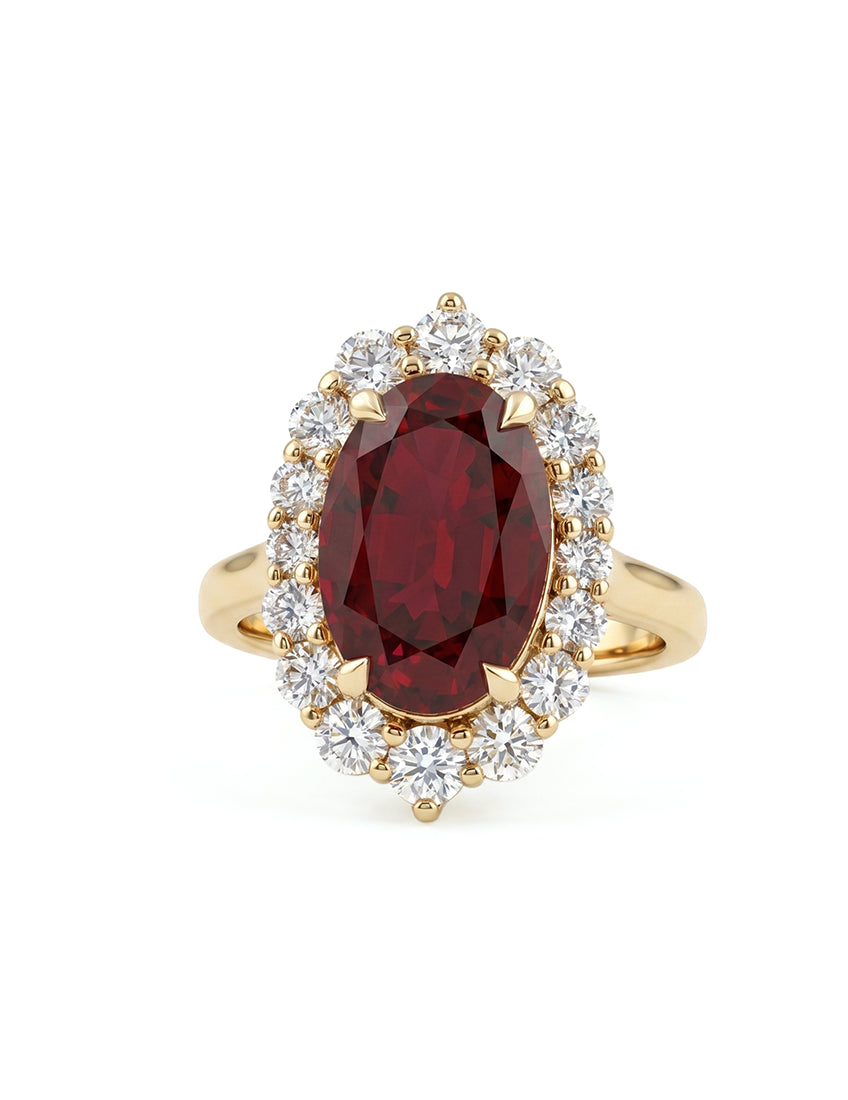
Wartime mine closures led to a scarcity of natural gemstones, and many Retro jewelers turned to clusters of small diamonds and halo settings as a way to maximize visual impact with available materials. The result was often a ring that looked substantial and dramatic without requiring a single large stone.
Retro pieces are scarce today because many were melted down or sold for scrap before the 1970s, before the antique jewelry market recognized their value. Surviving examples in good condition are increasingly collectible.
Diamond cut: Transitional cut or late old European cut Metal: Yellow gold, rose gold (platinum restricted) Best for: Buyers who want an antique halo with warmth and visual weight, and who prefer gold over platinum.
8. Mid-Century Modern Halo — Transitional Cut in Yellow or White Gold (1950–1965)
Mid-Century halo rings sit at the edge of the antique category — pieces made before 1926 are technically antique; those from 1926 onward are vintage — but they deserve inclusion here because they represent the final chapter of hand-cut diamond halo design before the modern round brilliant became universal.
Mid-Century halos often feature transitional cut diamonds: stones that were cut as the industry moved from old European proportions toward the mathematically optimized modern brilliant. These diamonds have a rounder outline than old Europeans but retain the higher crown and larger facets of the antique tradition. In a halo setting, they produce a light performance that’s somewhere between the romantic fire of an OEC and the sharp brilliance of a modern stone.
The settings in this period became cleaner and more minimal. Filigree largely disappeared. Milgrain became less common. The halo itself was often a simple pavé or bead-set ring of small diamonds, with less decorative metalwork on the shoulders and gallery. Yellow and white gold were both used, with platinum making a gradual return after wartime restrictions lifted.
For buyers who want a halo ring with genuine vintage character but find the Edwardian and Art Deco styles too ornate, Mid-Century pieces offer a middle path: hand-cut diamonds in cleaner, more wearable settings.
Old Gem House’s collection of vintage engagement rings includes pieces across all eight of these eras, with a particular depth in Edwardian and Art Deco styles where hand-cut diamonds and period metalwork intersect most dramatically. If you’re not finding exactly what you’re looking for in the existing inventory, their custom design service can reproduce any of these eight styles using authentic loose diamonds from the original periods.
Diamond cut: Transitional cut Metal: Yellow gold, white gold, platinum Best for: Buyers who want vintage diamond character in a simpler, more contemporary-looking setting.
Which Style Is Right for You?
The eight styles above cover roughly 250 years of halo ring design, from foil-backed Georgian rose cuts to clean Mid-Century transitional halos. The choice between them isn’t just aesthetic — it’s practical.
If wearability is the priority, Edwardian platinum filigree halos and Art Deco geometric halos are the most durable options. Georgian and early Victorian pieces are often too fragile for daily wear. If the diamond cut matters most, old mine cuts (Georgian through Victorian) produce a warmer, more candlelit glow; old European cuts (Edwardian through Art Deco) are rounder and slightly more brilliant; transitional cuts (Retro and Mid-Century) sit closest to the modern brilliant in light performance.
If rarity and investment value are considerations, Art Deco platinum halos with original OEC diamonds are currently among the most sought-after antique engagement ring styles, and finding examples with both a beautiful center stone and intact period metalwork is becoming genuinely difficult. Georgian pieces are rarer still, but their fragility limits the buyer pool.
For most buyers in 2026, the sweet spot is Edwardian or Art Deco — old enough to be genuinely antique, durable enough for everyday wear, and distinct enough that no two rings look exactly alike.