

How to Choose a Vintage Toi et Moi Ring: A Step-by-Step Buyer's Guide

Choosing a vintage toi et moi ring means selecting two stones that represent two people, set side by side in a single composition. The style traces back to 1796, when Napoleon proposed to Joséphine with a pear diamond and sapphire, and has appeared in every major jewelry era since. Get the era, the cut, the stone pairing, and the metal right, and you end up with a ring that reads as genuinely old rather than merely old-fashioned. Get any one of those wrong, and the whole piece can feel inconsistent. This guide walks through each decision in order.
Which historical era should a vintage toi et moi ring come from?
The era you choose sets every other decision, because each period had its own materials, techniques, and stone preferences.
Victorian rings (1837 to 1901) lean on 18-karat yellow gold, open-back gallery work, and symbolic stone choices. The Victorians treated gemstone selection as a private language, and the two-stone format gave that language its most personal expression. Old Mine cut diamonds appear frequently, often paired with rubies, sapphires, or colored paste in elaborate collet settings.
Edwardian pieces (1901 to 1915) introduced platinum and milgrain detailing. Advances in platinum jewelry allowed for increasingly delicate settings: fine openwork, engraving, and gracefully structured galleries that surround the two stones without adding visual weight. Old European cut diamonds dominate this period.
Art Deco rings (roughly 1920 to 1935) moved in a different direction entirely. The style embraced bold geometry and striking visual contrast, combining diamonds with vividly colored gemstones in angular, architectural compositions. Symmetry was deliberate, and platinum was the standard metal.
Mid-Century examples (1940s to 1950s) tend toward heavier yellow gold settings with a softer, more sculptural quality. Stones sit lower in the mount, and the overall silhouette is rounder than the geometric Deco pieces that preceded them.
Decide which era matches the wearer’s aesthetic before shopping. A Victorian ring and an Art Deco ring can both be authentic vintage toi et moi rings, but they look nothing alike.
Which antique diamond cut works best in a toi et moi setting?
The three cuts you will encounter most often in vintage toi et moi rings are the Old Mine cut, the Old European cut, and the Rose cut. Each interacts with light differently, and each belongs to a specific historical window.
Old Mine cuts are cushion-shaped with a high crown, a small table, and a notably large open culet. They dominated Georgian and Victorian jewelry, and they produce chunky, warm flashes that read beautifully under candlelight or restaurant lighting. The slightly irregular outline means no two stones look identical, which suits the toi et moi format well: the pair feels like two distinct personalities rather than a matched set.
Old European cuts refined the outline into a rounder, more symmetrical shape while keeping the small table, high crown, and open culet. They were the standard through the late Victorian, Edwardian, and Art Deco years. The facets are longer than an Old Mine’s, returning more light through the table and producing a warm, broad flash that sits somewhere between an Old Mine and a modern brilliant.
Rose cuts are the oldest of the three and the simplest to recognize. The back is flat, the crown rises as a low dome of triangular facets, and there is no pavilion at all. Without a pavilion, there is little brilliance in the conventional sense; instead the stone glows with a soft, even light across the whole dome. Rose cuts sit flat and low in their settings, covering more finger surface than their carat weight suggests, which makes them a strong choice when one of the two stones needs visual presence without added height.
For a toi et moi, pairing two Old Europeans of similar size produces a balanced, cohesive look. Pairing an Old Mine with a Rose cut introduces deliberate contrast in both light behavior and silhouette, which can work well when the two stones are meant to feel like distinct characters. Old Gem House has sourced and set hand-cut diamonds across all three of these categories since 2012, so their team can help you evaluate specific stones side by side before committing.
How do you choose the right stone pairing for a vintage toi et moi ring?
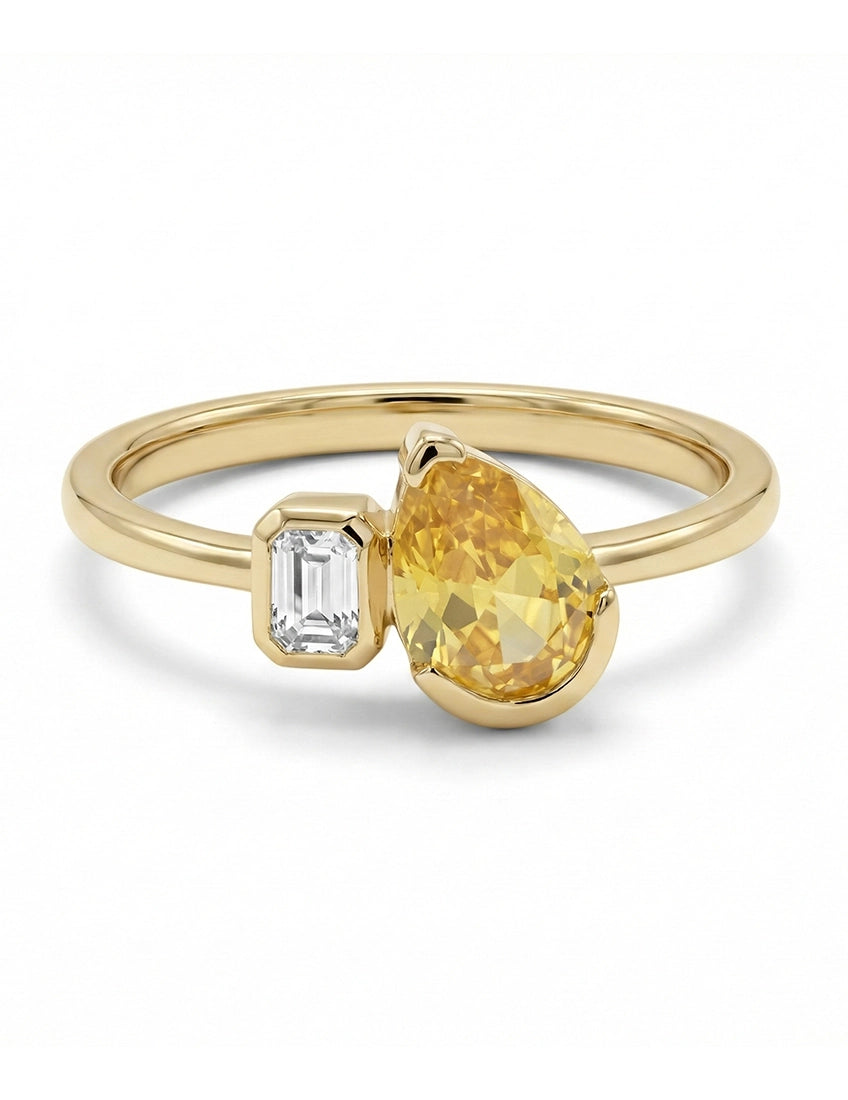
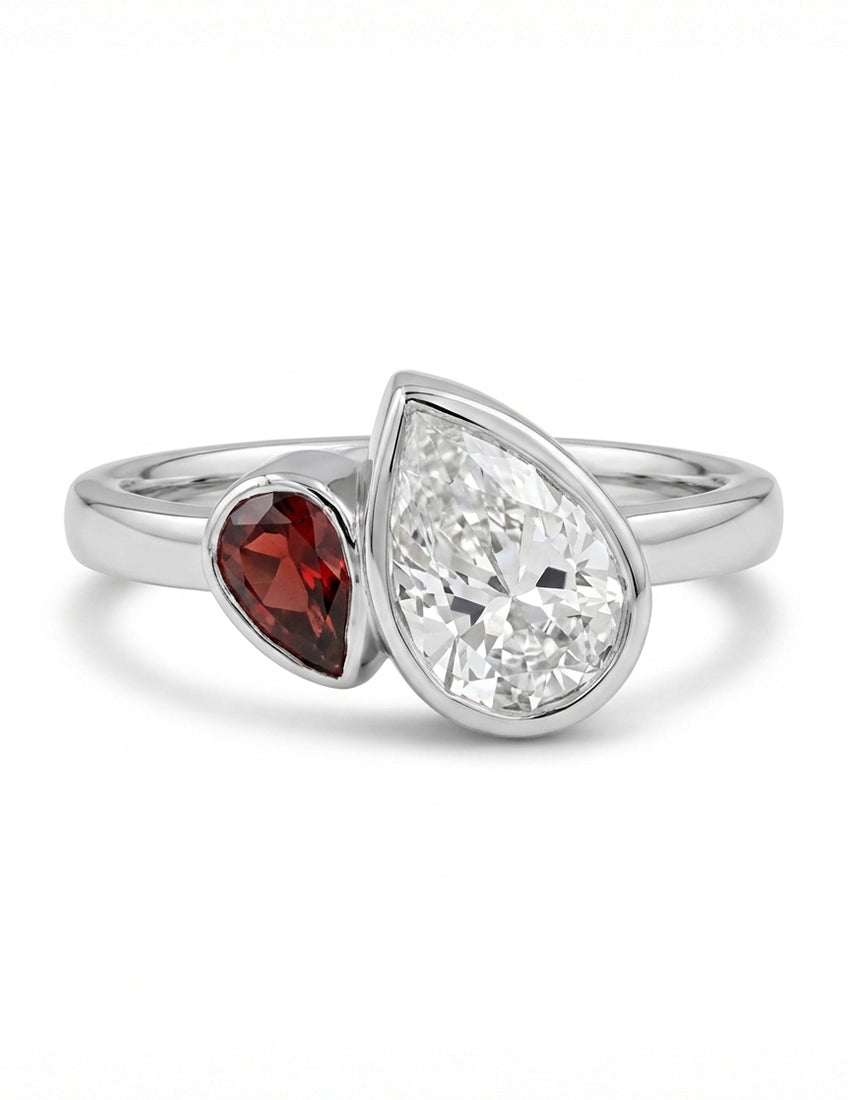
Stone pairing is where the ring becomes personal. The two main routes are diamond plus diamond, and diamond plus a colored gemstone.
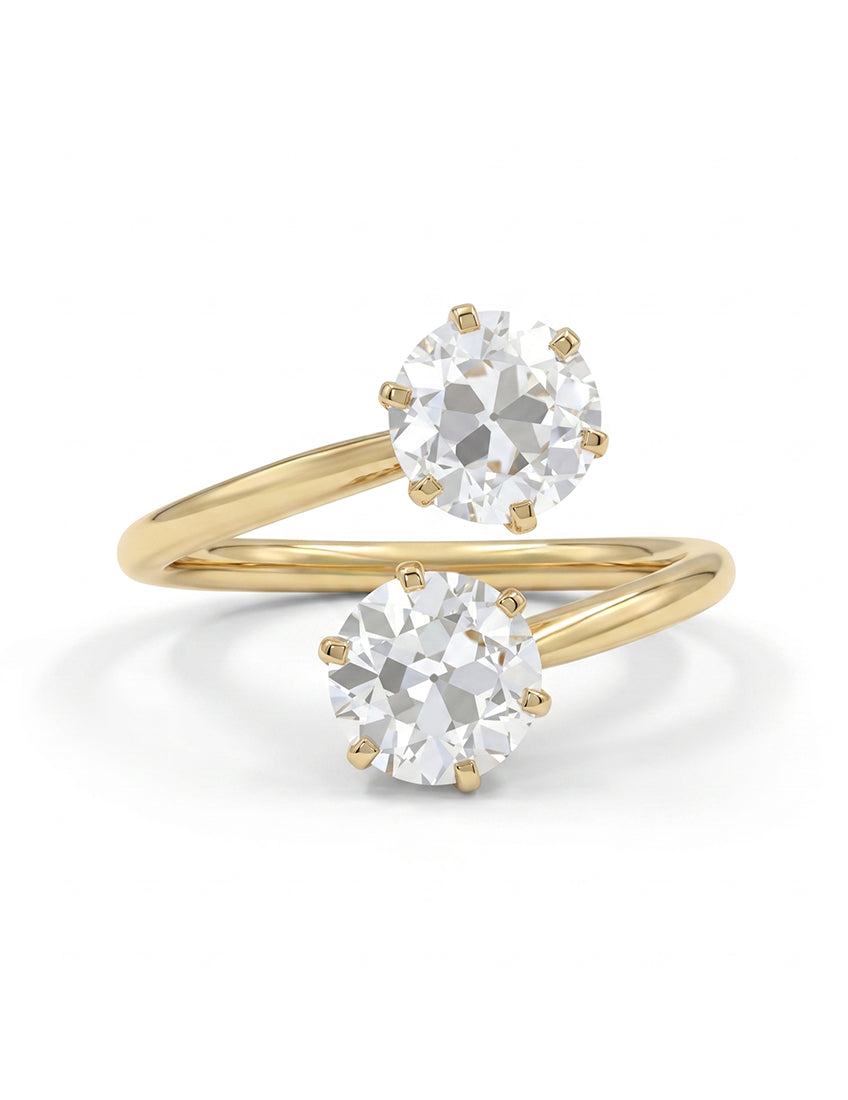
Two diamonds create a cohesive, symmetrical composition. The stones do not need identical carat weights; face-up dimensions, shape, and orientation determine whether the pair feels balanced. Mixing an oval Old European with a cushion Old Mine, for example, produces a composition that reads as complementary rather than mismatched.
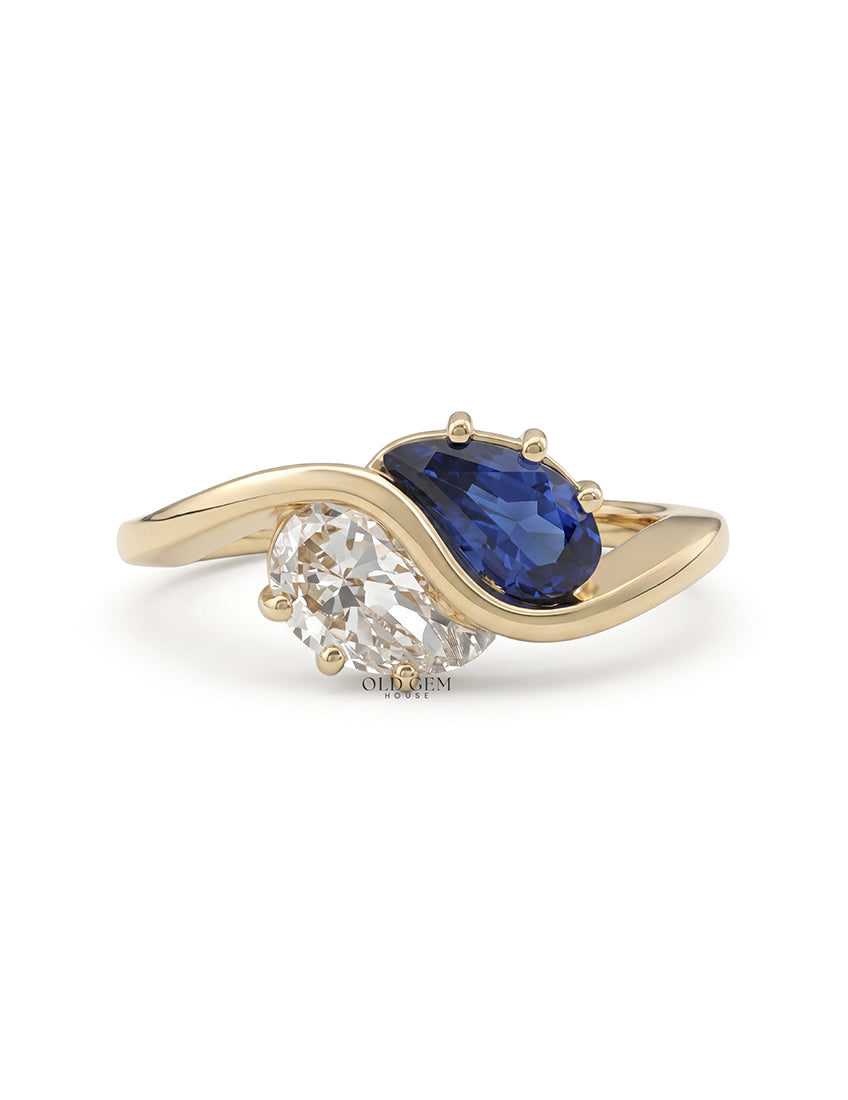
Diamond and sapphire is the original pairing, echoing Napoleon’s 1796 ring most closely. Sapphires sit at 9 on the Mohs hardness scale, making them well-suited to daily wear, and their blue depth reads as a strong visual counterpoint to a colorless diamond. In a Victorian or Edwardian setting, the combination feels historically grounded.
Diamond and emerald references the ring John F. Kennedy gave to Jackie Bouvier: a 2.84-carat emerald paired with a 2.88-carat diamond, two stones of nearly equal weight. The pairing feels luxurious and distinctive, but emeralds sit at roughly 7.5 to 8 on the Mohs scale and chip more easily than sapphires, so a bezel or protective setting is worth considering for a ring worn every day.
Pink sapphire works particularly well in Victorian-inspired designs, where the color reads as romantic without being overly bold. For Art Deco settings, deeper-toned stones like blue sapphires and emeralds suit the period’s preference for high contrast.
The Art Deco Pear Blue Gemstone Toi Et Moi Engagement Ring from Old Gem House’s collection shows how a pear-shaped gemstone and diamond can sit in natural visual harmony within a period-correct Art Deco frame.
Does the metal type change how a vintage toi et moi ring looks and wears?
Metal choice affects color, durability, and how closely the finished ring aligns with a specific historical period.
Yellow gold (18 karat) is the correct choice for Victorian and Georgian rings. It introduces warmth and contrast against the stones, and it frames Old Mine cuts in a way that platinum simply does not. Clients who want antique references and old-cut stones often find that yellow gold makes those ideas feel coherent and wearable. The metal develops a patina over decades, which adds to the ring’s sense of age.
Platinum belongs to the Edwardian and Art Deco periods. It is naturally white with no plating required, and at 95% purity it holds prongs securely over long-term wear. Platinum settings typically run 20 to 40% more than comparable 18-karat white gold designs, with the gap widening in heavier or more intricate pieces. For a ring with detailed milgrain or engraved gallery work, that premium tends to be worth it, because engraving reads more crisply in platinum than in plated metals.
18-karat white gold is a reasonable substitute for platinum in Art Deco-style settings when budget is a constraint, though it requires periodic rhodium replating to maintain its bright finish.
For a two-tone approach, a yellow gold shank with a platinum or white gold head is historically appropriate in some late Victorian and early Edwardian pieces, and it keeps the stone-holding portion in the more secure metal while preserving the warmth of gold on the hand.
How do you commission a bespoke vintage toi et moi ring?
Commissioning a custom piece gives you control over every variable: the era, the cuts, the stone pairing, and the metal. It also means the ring is made in solid gold or platinum rather than in a plated base metal, which matters for longevity.
Start by identifying the historical era and the cuts you want, using the steps above. Then source the stones before designing the setting, not after. Antique hand-cut diamonds are one-of-a-kind; the setting should be built around the stones rather than the other way around. A good jeweler will let you see the two stones together before any metalwork begins, so you can judge how they read as a pair in natural light.
Ask specifically about the gallery construction. In period-correct vintage settings, the gallery (the metalwork beneath the stones) is as considered as the top of the ring. Closed-back settings belong to the Georgian period; open-back galleries with claw or collet prongs are Victorian; milgrain-edged open galleries are Edwardian. Getting this detail right is what separates a ring that looks genuinely old from one that looks like a costume piece.
Expect the process to take eight to twelve weeks from stone selection to finished ring for a fully custom piece. Families with deep experience in this niche, like the team at Old Gem House, can walk you through stone selection and setting design in a single conversation, which shortens the decision timeline considerably. Browse the Toi-Moi Ring collection to see current examples of how antique cuts translate into finished settings.
The Era-and-Cut Match Is What Decides It
Every other choice in this guide flows from two decisions made early: the historical era and the diamond cut. Get those two aligned, and the stone pairing, the metal, and the setting style tend to follow logically. A Victorian ring in yellow gold with Old Mine cuts and a sapphire accent is internally consistent. An Edwardian ring in platinum with Old Europeans and milgrain detailing is internally consistent. Mixing elements from incompatible periods produces a ring that looks assembled rather than designed.
If you are commissioning a bespoke piece, the Old European Round Cut Bypass Toi Et Moi Ring offers a concrete reference point for how two antique-cut diamonds can sit in balanced conversation within a period-correct Art Deco frame.
Frequently Asked Questions
How do I know if a toi et moi ring is genuinely vintage rather than a vintage-style reproduction?
A genuinely vintage ring will show hand-cut diamonds with slightly irregular facets, an open culet visible face-up, and gallery construction consistent with the claimed period. A jeweler experienced with antique cuts can confirm whether the stones are period Old Mine, Old European, or Rose cuts versus later re-cuts set into an antique-style mounting.
Do the two stones in a toi et moi ring need to be the same carat weight?
No. The stones do not need identical carat weights. What matters is that their face-up dimensions, shapes, and orientations create a visually balanced composition. A slightly heavier stone in a lower-profile cut can read as the same size as a lighter stone in a taller setting, so always evaluate the pair together rather than comparing weights on paper.
What is the difference between an Old Mine cut and an Old European cut in a toi et moi setting?
An Old Mine cut is cushion-shaped with a large open culet, producing chunky warm flashes suited to Victorian and Georgian rings. An Old European cut is round with a slightly smaller culet and longer facets, producing a more refined light return suited to Edwardian and Art Deco settings. Both are hand-cut and no two are identical, which gives a toi et moi ring its character.
Can I pair two different antique diamond cuts in one toi et moi ring?
Yes, and it can work well when the cuts are chosen to feel complementary rather than random. An Old Mine cushion beside a Rose cut, for example, contrasts a deep stone with a flat one, creating visual interest without clashing. The key is that the pair reads as a considered decision rather than a mismatch, which is easier to judge in person than from photographs.
How much should I expect to spend on a vintage toi et moi engagement ring?
Price varies widely depending on stone quality, carat weight, metal, and whether the ring is a curated antique or a custom piece. Antique-inspired designs with lab-grown stones can start around $335 to $500, while rings set with natural hand-cut diamonds in solid gold or platinum typically begin around $1,000 and rise well above $4,000 for larger or rarer stones. The metal and gallery construction add cost that is not always visible in photographs, so ask for a full breakdown before comparing prices across sellers.